Thursday, April 7, 2011

Some Park Action

In between days of snow or rain, when the sun was actually shining,
we took Peanut to the park.

He is such the stereotypical boy.

He loves to run and jump. Throw rocks and collect sticks.
Chase birds and squash bugs.


We travel with an assortment of balls ...
soccer, baseball, football, golf, tennis, basketball.

He loves to throw, catch, kick, hit, shoot ...
You name it, he does it.
(Except for talk, but that's a whole different story.)

Having a ball makes everything right in the world.
At least in Peanut's world.

Thursday, March 24, 2011

Symptoms?

We met with the local radiation oncologist today to review the MRI from Texas and just to follow-up on things here. I was glad we had the appointment, because remember how the doctors in Texas said E. had to report any symptoms immediately? Well ....

For the past few weeks, E.'s been having more and more "symptoms" ... short term memory loss, right leg weakness, balance issues, headaches, irritability and fatigue. It has been slightly concerning. No, make that HUGELY concerning. In typical fashion, E.'s been brushing them off and I've been freaking myself out.

The radiation oncologist put E. through a series of neurological tests, which he seemed to pass with flying colors. That is, except for walking heal to toe in a straight line. Let's just hope he doesn't get pulled over for any field sobriety tests any time soon.

The radiation oncologist reviewed the MRI that we brought back with us from Texas. He actually liked what he saw. Matter of fact, he said that if E. weren't having any of these symptoms, he'd of said everything looked great and that he'd see us again in three months. He indicated that recurrences usually occurred in the nodules rather than the walls, and that the cavities where the tumors/nodules had been looked great. He agreed that there was more enhancement in the walls, but didn't think it looked suspicious at all. He also commented that the walls looked fuzzier, which would be consistent with a delayed reaction from the radiation treatment. He remarked that while this was on the outside edge of the timeframe for the delayed reaction, it still wasn't unheard of.

He also noticed some swelling, particularly around the post-operative cavities. Again, he stated that it could be delayed swelling from the surgical procedure itself and the subsequent Cyberknife treatments. The symptoms E. is presenting could very well be the result of the swelling that is currently present. In order to treat that swelling, E. is going to have to go back on a course of steroids. Unfortunately, steroids have a tendency to make people cranky. A cranky E. is a small price to pay to get rid of these symptoms though. And if it means swelling over cancer, we'll take it any day!

Oh, and do you happen to remember what steroids do to blood sugar levels? You guessed it. They make things all out of whack. E. is already back on the insulin at a minimum dose to try to keep things somewhat stable before they get too out of control. He is not a happy camper.


Tuesday, March 22, 2011

One Down, One Up

E. met with the family doctor today to go over some recent labs and such. He was thrilled to learn that he no longer has to take the insulin as his blood sugar levels seem to have finally stabilized. Not only is that one less med, but it also means that he doesn't have to get those daily shots anymore. Woohoo! But ... it seems as if his cholesterol level needs some help. So, he's on a new med for that. At least it's not a shot, right?

Tuesday, March 8, 2011

Two

Since two years has passed since E.'s diagnosis, it seems only reasonable that Peanut is turning two. After all, he was born a few short weeks after we first learned E. had cancer. And yet, it doesn't seem possible. It doesn't seem possible that two years has already gone by. It doesn't seem possible that one precious little munchkin has brought so much joy to our lives in two years.


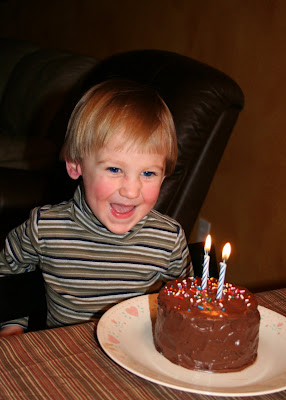
He looks thrilled about his birthday cake, doesn't he?
He was actually thrilled about the candles.
He blew them out with much gusto, just as soon as they were lit.
Then he blew them out again.
And again.
And again.
And again.
It was the highlight of the night, I'll tell ya.


Mmmmm.
Yummy.


His new ride.
As you can tell, he loves it.
His legs are just long enough so that his feet reach the pedals
They are not long enough though that he can actually pedal,
which causes great frustration.
Thankfully, there are many volunteers who can push him around.


I realize he may look like he is throwing a gang sign here.
What he's actually doing is showing us that he's "2."
Yeah, he doesn't quite have that down yet.
We'll work on that.


Happy Birthday beautiful boy.
We love you Peanut
and are so glad you blessed our lives.

Thursday, March 3, 2011

"Changes"

Today we met with E.'s oncologist.

The PET/CT looked good. "There is no abnormal activity along the esophagus. There are no enlarged FDG-avid nodes in the mediastinum, paraesophageal, axillary, left gastric, abdominal or retroperitoneal regions. Normal tracer activity seen in the liver, spleen, adrenals, or visualized bone marrow."

The MRI is questionable. "There is a decrease is size of the surgical cavity within the right frontal lobe. Marginal enhancement surrounding the resection activity is more prominent; however, still within the realm of postoperative enhancement. This bears close followup to exclude recurrent tumor."

E.'s oncologist said there are definite changes in E.'s brain, which is a possible consequence of surgery, but could be a possible consequence of recurrent cancer. He recommended that we consult with a neuro-surgeon to see if any intervention is needed.

We then met with a neuro-oncologist at the Brain and Spine Center.

She reviewed E.'s history and agreed with the conclusion that E. was probably having focal or partial seizures rather than generalized seizures. She found it interesting that E. is slowly titrating on the Keppra and then will be slowly weaning off the Dilantin ... in her practice, they start and stop those meds abruptly.

She reviewed the MRI. While the cavity where the front tumor was is smaller, the walls are thicker. And they are more "enhanced." "Enhanced" means brighter. So, looking at the MRI, the walls around the cavity are thicker and are glowing much brighter. As you may recall, when you're looking at an MRI, you really don't want anything to glow brightly! The neuro-oncologist did say that sometimes "enhancement" is caused by healing from radiation and the "time is right for radiation induced changes." She pointed out some white cloudy areas around the cavity, which she explained could be swelling caused by a tumor.

She really didn't have anything definitive to say. She summarized by saying, "Based on my assessment, 1. Right now, I do not know what's in there. And 2. I am going to need to repeat the MRI in two or three months. If it is stable or improved, that will show that it is side effects from the treatment. If it is worse, that will show it is the tumor coming back." Furthermore, she stated that during that interval of time, if E. develops any symptoms such as vision trouble, increased seizures, headaches, disorientation, etc, he is to report them immediately.

We then got a call from the thoracic surgeon's physician's assistant. She wanted us to come over so they could see us before we left. She called the surgeon out of a meeting, simply so he could touch base with us. They had both reviewed the PET/CT and MRI reports and were full of optimism. Essentially, there is nothing that can be done about it right now anyways, so we are not to let it consume our lives. "Go, live life, enjoy .... and we'll see you in three months." It was just the pep talk we needed to end our visit.

Wednesday, March 2, 2011

Long Day of Tests

The day's original schedule looked like this:

7:00 am Chest X-Ray
7:30 am PET Prep
8:00 am PET/CT Injection and Localization
9:30 am PET/CT
11:00 am Appt. with Thoracic Surgeon
12:30 pm MRI Prep
1:00 pm MRI with and without Contrast
2:30 pm Labs

Things were cruising along just fine until 8:00 a.m. For the many of the tests and scans you undergo, there are specific instructions. The PET/CT is no exception. The folks called last night to confirm the appointment and go over the instructions. E. was to eat no food for six hours prior to the PET, but could drink water. He was instructed though to take all his usual medications. He clarified that he was supposed to take both his anti-seizure and his diabetes medications in the morning prior to the test. Affirmative.

Oops. He was supposed to take all his usual medications EXCEPT his diabetes medications. We should know that by now, but honestly as familiar as these tests become, sometimes they all kind of blend together and it's hard to remember which instructions were for which test. They sent E. to the cafeteria with orders to eat a high protein breakfast and drink lots of water. He was then to return to Take #2 of the PET at 3:00. So, basically, the morning appointments got shifted to the afternoon.

The one appointment that we had to cancel was with the thoracic surgeon. Since E. didn't have any tests or scans completed, there wasn't really anything we could discuss with him, unless we just wanted to chit chat. We were both disappointed as the thoracic surgeon and his physician's assistant are by far our favorites. They have gone way above and beyond in E.'s treatment and we trust them implicitly. The strange thing is that after that rogue malignant lymph node was found during our first visit to MD Anderson, surgery was essentially taken off the table for E. That means that E. really has no need for a thoracic surgeon to even be on his team. I think the surgeon and his P.A. must be kind of partial to E. too because they always want to see him too. The thoracic surgeon doesn't see patients on Thursday, but the P.A. said that they would consult with us by phone and make sure to meet up with us on our next trip to Texas.

E. didn't finish with his scans until almost 6:00. Whew. Is it bedtime yet?

Wednesday, February 23, 2011

Neurologist Appt.

We met with the neurologist, who decided that E. was probably in fact having seizures. The spikes in his EEG coupled with his self-reports of momentary bouts of dizziness and disorientation (lasting a couple of seconds at most and happening up to a few times a week) led her to believe that he's experiencing seizure activity. In order to be sure, he could be monitored for 24 hours a day in hopes that a seizure could be recorded, but there's a high probability that we wouldn't even be able to time things right and nothing would be documented. In the end, the odds are that it would just be a waste of everyone's time.

The anti-seizure medication (Dilantin) that E. is currently taking seems to be doing a good job keeping the seizures at bay, but the problem is that Dilantin isn't an ideal medication for long-term use. Long-term side effects can include dental issues (specifically regarding the gums) and bone disease (specifically weakening of the bones). Since it looks like E. could potentially be on anti-seizure medication for the long haul ... like twenty or thirty years! ... it's time to switch to a different medication. Enter Keppra. With these anti-seizure medications, it is not a simply as stopping one and starting another though.

E. will begin taking the Keppra by taking one pill each evening for five days, while continuing to take the Dilantin. He will then take one in the morning and one in the evening for five days. Then one in the morning and two in the evening. On and on it goes until he reaches three pills in the morning and three pills in the evening. Once he's reached that dosage and stabilizes there for a few weeks, we'll touch base with the doctor again. Then, after a couple of months, he can begin to wean off the Dilantin. It is quite the process.

Of all the anti-seizure medications available, it seems that people tolerate Keppra the best for long-term use. Approximately 15-20% of folks though seem to have increased moodiness and irritability. Cross your fingers that E. is in the majority, not in the minority for this statistic.

The neurologist was optimistic that the Keppra would be all that was needed to keep E. seizure free. She was not surprised that he was experiencing seizure activity, considering all that his brain has been through. There isn't really much follow-up needed other than monitoring the medication, and another EEG isn't even foreseen unless there are some drastic changes. The doctor did mention that in periods of severe stress or illness, E.'s seizures may increase in intensity or frequency. If that happens, there's another medication that he can take to help through those times as well.

Next up: Texas. It snuck up on us this time, but it's almost here again. All day of travel on Tuesday the 1st, all day of tests and scans on Wednesday the 2nd, doctors' appointments the morning of Thursday the 3rd and then home that evening. As always, positive vibes, good thoughts and prayers are appreciated.